 Connected Craftsman LLC
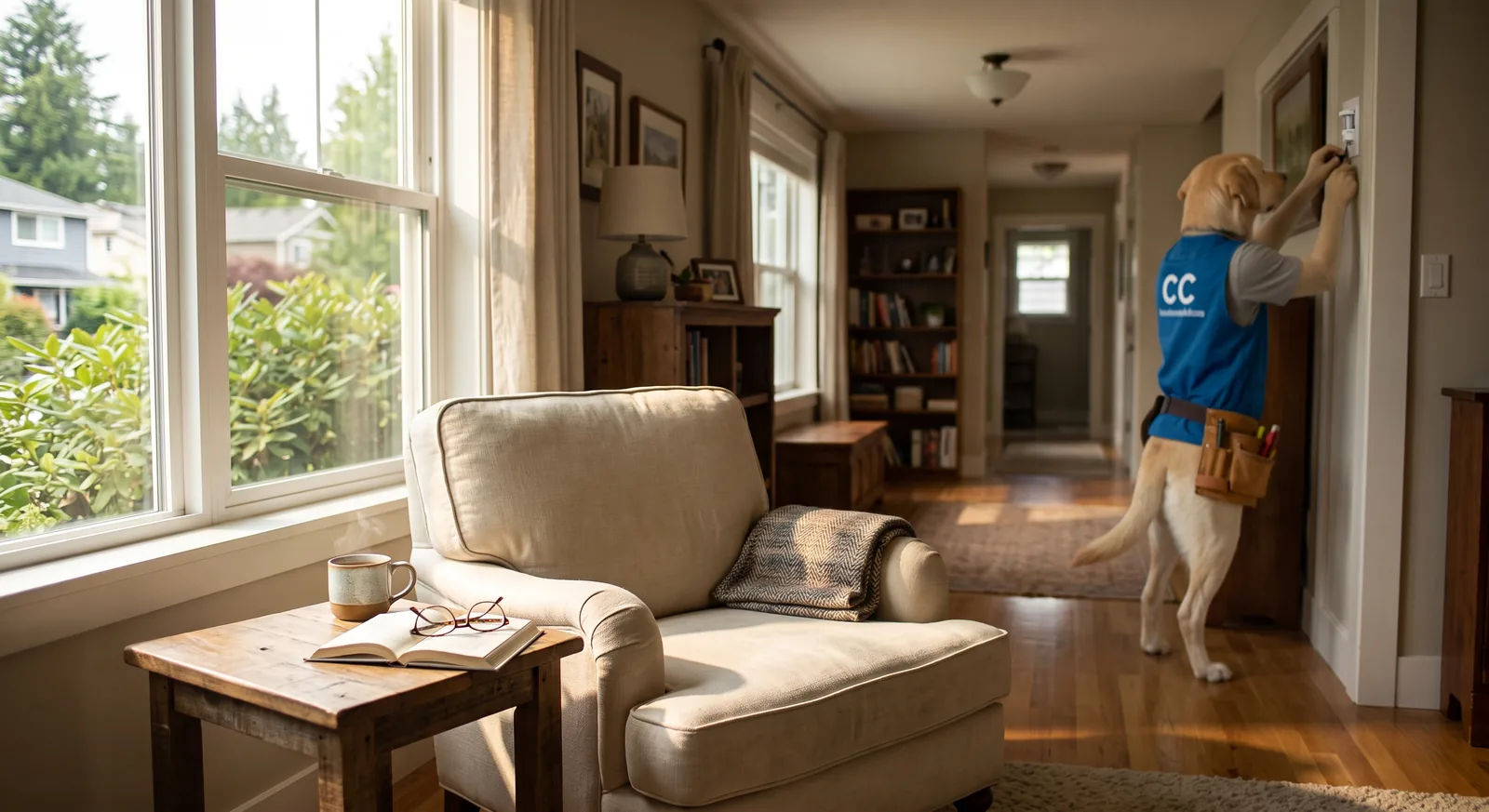
Watching a parent insist they're fine living alone, while you quietly do the math on how far away you are and how fast you could get there, is its own particular kind of stress. You can't fix everything from a distance. But a surprising amount of real risk in a home can be reduced with practical, unglamorous fixes — and someone else can usually do the actual work.
Here's what tends to worry families most, and what generally helps.
1. Fall Risk
According to the CDC, falls are the leading cause of injury-related hospital visits for older adults, and most happen in predictable places — stairs, bathrooms, and hallways with weak lighting. These are also the cheapest and fastest hazards to fix, once someone actually gets to them.
Properly anchored grab bars (into wall studs, not just drywall) at the tub, shower, and toilet make a real difference, as do non-slip surfaces on wet floors and secured handrails on stairs. Better lighting — especially motion-activated fixtures in hallways and stairwells — removes one of the most common causes of nighttime falls: fumbling for a switch in the dark. Connected smoke and CO detectors are also worth checking, since they're easy to forget about entirely from a distance.
2. Not Knowing What's Actually Wrong With the House
Maybe you visit twice a year. Maybe a sibling lives closer but isn't exactly detail-oriented about loose railings or worn grout. Either way, a lot of decisions get made about a house nobody in the family is currently looking at closely.
A walkthrough — in person or over video — with someone who knows what to look for is usually the most useful first step. The goal is a plain-English list that separates real safety issues from things that are simply cosmetic, so decisions get made with actual information rather than guesswork or secondhand impressions.
3. Trusting a Stranger in a Parent's Home
This is a reasonable thing to be careful about, not an overreaction. A parent who trusts easily, or who might not push back on a pushy salesperson, is in a more vulnerable position than most homeowners.
A local, established business with an actual reputation in the community is generally a safer bet than someone found through a one-off app booking — there's more at stake for them in treating the job, and the person, well. It's also reasonable to ask to be looped in directly: a call before work starts, photos when it's done, whatever makes the arrangement feel transparent from a distance.
4. Approaching the Conversation With Respect
This is often the hardest part — not the house, but the conversation. Nobody wants to feel like their independence is being taken away from them, even gently, and even by people who love them. Leading with "you need this because you're getting older" can put a parent on the defensive fast, whether or not the underlying concern is real.
What tends to work better is including a parent in the decision rather than making it for them. Ask what would actually make daily life easier or more convenient for them, rather than presenting a list of things they supposedly can't do anymore. Many of the same upgrades that reduce fall risk or ease worry also happen to be genuinely useful on their own terms — a video doorbell so they can see who's outside without crossing the house, a smart lock so they're not fumbling with keys, better lighting in a hallway they've always found too dim. Offered as improvements a parent gets to choose, not decline, these conversations tend to go a lot better than ones that start from a place of "you can't."
5. Cost and Not Wanting to Be Oversold
Between worrying it isn't enough and worrying about being talked into an unnecessary renovation, cost concerns are legitimate — especially when siblings are involved and don't agree on priorities.
Most of the highest-impact safety work isn't a full remodel. Grab bars, railing repairs, lighting upgrades, and a few smart home basics address a large share of real risk for a fraction of the cost of a full accessible bathroom renovation. It's worth being skeptical of anyone who leads with a large project before walking the house and explaining why.
Local Resources Worth Knowing About
If a parent's home is in Chester County, there are a couple of programs worth calling about before this comes entirely out of pocket.
The Housing Partnership of Chester County — based right here in Downingtown — runs a Senior Citizen Home Maintenance Program: a one-time grant of up to $6,000 for home maintenance, repairs, and access modifications. It's open to homeowners 65 and older who own and occupy the property as their primary residence and fall within the program's income limits. Call 610-518-1522 for current eligibility details and an application.
The Chester County Department of Aging Services (610-344-6000) runs the Family Caregiver Support Program for people supporting a parent or relative — a one-time grant of up to $5,000 to purchase home modifications and assistive devices like wheelchair ramps, shower rails, and hand rails, with modifications approved before work starts. The same office's OPTIONS Program serves residents 60 and older, but covers a different mix of support — care management, home support services, Meals on Wheels, personal care, and personal emergency response systems, on a sliding co-pay scale based on income — not home modifications directly.
Program details like these change — funding runs out, income limits get updated, waitlists open and close. What's above was accurate as of September 2026, but confirm current eligibility and availability directly with the program before counting on it.
Know the Limits
None of this replaces a doctor's guidance, a professional home safety assessment, or the judgment of a geriatric care manager if a parent's situation calls for a higher level of care. What these fixes address is the house itself — the everyday hazards that are often the most solvable part of a much harder situation.
If you're coordinating from out of town, Connected Craftsman is happy to walk the house with your parent and keep you in the loop the whole way — photos, plain explanations, no surprises on the bill.