 Connected Craftsman LLC
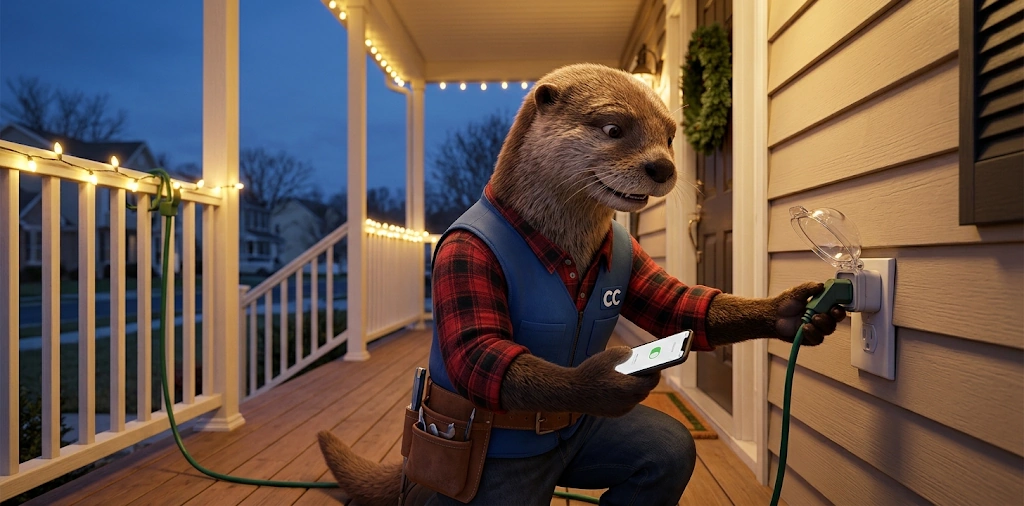
Every year somebody hangs the lights, plugs them in, and nothing happens. Or they work for two nights and then quit after the first rain. Nine times out of ten the lights are fine. The problem is the outlet they are plugged into, or the outlet that outlet is wired through.
Here is what I would check before the ladder comes out, and what to know if you want the lights on a phone schedule this year.
First: Find the Outlet That Actually Controls the Porch
Outdoor outlets have to be protected by a GFCI, the kind of outlet with TEST and RESET buttons. It cuts the power when it senses current leaking somewhere it should not, which is exactly what water does.
The catch is that the GFCI protecting your outside outlet is often not the outside outlet. In a lot of older Downingtown and Coatesville houses, the porch outlet is wired through a GFCI in the garage, a bathroom, or the basement. If the porch outlet is dead, walk the house and press RESET on every GFCI you can find before you assume anything is broken. Then check the breaker panel.
If a GFCI will not reset at all, or trips again the moment you plug in the lights, stop there. That is telling you something.
Second: Why It Trips After It Rains
A GFCI that trips on wet nights is usually doing its job. The common causes:
- A plug connection sitting in a puddle or lying on wet grass. Lift the connections off the ground. A stake, a hook or a zip tie to the railing is enough.
- An old cover that only closes when nothing is plugged in. Outdoor outlets that are used with something plugged in should have a deep "in-use" cover, the bubble kind that closes over the cord. A flat flip cover keeps water out only when the outlet is empty.
- Indoor-rated extension cords or power strips outside. Check the cord jacket or the package. If it does not say it is rated for outdoor use, it belongs inside.
- An old string with cracked insulation. Plug strands in one at a time to find the one that trips it.
What not to do: replace a GFCI that keeps tripping with a regular outlet so it "stops doing that." It stops doing that by no longer protecting anyone.
Third: How Much You Are Putting on One Outlet
LED light strings draw very little, and most of the old rules about how many strands you can connect came from the incandescent days. Still, every string has a maximum printed on its tag or box, usually as a number of sets or a wattage. Stay under it. If you are mixing old incandescent strings with new LED ones, the old strings set the limit.
Fourth: Outdoor Smart Plugs, and the Wi-Fi Question
A smart plug lets you turn the lights on at sunset and off at bedtime from your phone, without going outside in the cold. It is one of the cheapest smart-home upgrades there is. Three things to check first:
- Buy one made for outdoors. An indoor smart plug inside a plastic bag is not an outdoor smart plug. Outdoor models are sealed and usually have a cover over the unused socket.
- Make sure Wi-Fi reaches it. This is where most of them fail. Stand at the outlet with your phone and check the signal. If your phone barely connects there, the plug will drop off too, and the schedule will quietly stop working. Most smart plugs only use the 2.4 GHz band, so connect them to that network if your router splits them.
- Use the sunset setting, not a fixed time. Most smart plug apps can follow sunset for your location, so you do not have to change the schedule as sunset shifts through the season.
If the front of the house is a Wi-Fi dead zone, the fix is usually where the router or mesh point sits inside, not a stronger plug.
When You Do Not Need to Hire Anyone
Resetting a GFCI, lifting connections off the ground, swapping in an outdoor-rated cord and setting up a smart plug are all things you can do yourself this weekend.
If there is no outdoor outlet where you need one, that is a job for an electrician. We repair and replace what is on your existing wiring, but we do not add or extend circuits.
If the GFCI will not reset, the outlet cover is cracked, or the Wi-Fi does not reach the front porch, that is the kind of thing we fix across Downingtown, Exton, West Chester and the rest of Chester County.