 Connected Craftsman LLC
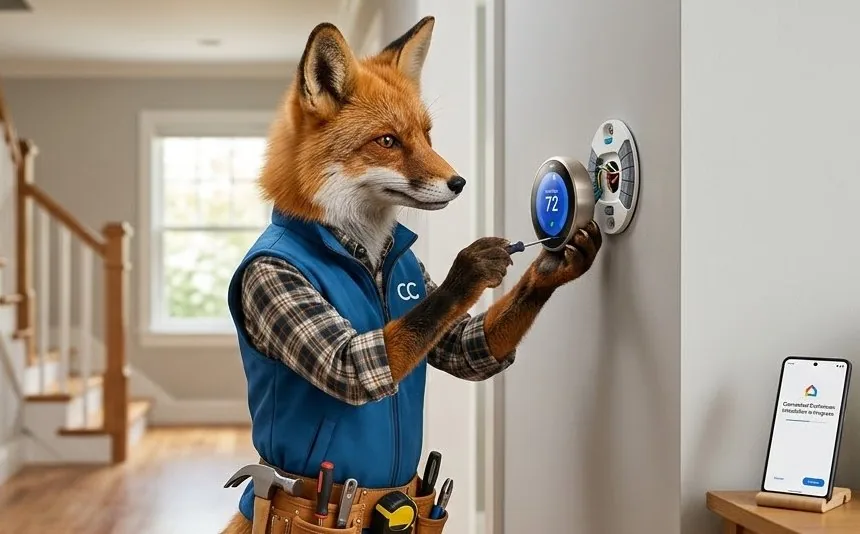
A smart thermostat is a small computer. The screen is on, the Wi-Fi radio is listening, and it is doing that around the clock — which means it needs power around the clock. That is what the C wire is for. C is for "common," and it completes a circuit back to the furnace so the thermostat has continuous 24-volt power that does not depend on the heat being on.
Older systems did not need one. A basic thermostat is a switch. It closes a contact, the furnace runs, and the thermostat itself draws almost nothing. So a house wired for a 1990s thermostat often has four wires — R, W, Y and G, for power, heat, cool and fan — and no C.
How to Check, in About Five Minutes
All you need is a screwdriver.
- Turn off the system at the thermostat. If you have a breaker or a switch for the furnace, turn that off too. This matters more than it sounds like it does.
- Pull the thermostat face off the wall plate. Most of them unclip; some have two screws under the bottom edge.
- Look at the terminal block underneath and write down every letter that has a wire in it.
- Look for a terminal marked C with a wire actually landed in it. A labeled terminal with nothing in it does not count — that is the whole point of checking.
- Check for a spare wire pushed to the back of the wall box and not connected to anything. That is often a spare, and if it is, the job gets much easier.
If You Have a C Wire
If you have a C wire and your heat comes from a furnace or a boiler, the swap is a genuinely straightforward job. Label the wires, photograph the terminal block before you disconnect anything, and most people can do it themselves in half an hour. You do not need to hire anyone for that.
If You Have a Heat Pump
If you have a heat pump, the C wire is not the whole question. A heat pump has a reversing valve, and a single wire — landed in O on most systems, in B on some — tells it which way round to run. Which one you have gets set in the thermostat's own setup menu, not on the wall plate, and it is the step people skip because by then the thermostat is on the wall and working. Get it wrong and nothing looks wrong. It powers up, it joins the Wi-Fi, it heats the house all winter. You find out on the first warm day, when you ask it for cooling and the house gets hotter. So on a heat pump, count the wires — but the one that catches people is O or B.
If You Don't Have a C Wire
There are three honest routes:
- Run a new cable from the furnace to the thermostat. The right answer where the wall cavity allows it, and the least fun where it does not.
- Use the adapter the manufacturer supplies. Ecobee ships a Power Extender Kit that repurposes the fan wire to do two jobs. It goes in at the furnace end, not the wall end, which is why it stops most people — it means opening the air handler and working on a board.
- Rely on power stealing. A Nest can trickle power through the heating circuit when the system is idle. It works in plenty of houses. Where it does not, the symptom is not a dead thermostat — it's a thermostat that drops off Wi-Fi, or a furnace that short-cycles, weeks after the install, in the cold, when nobody connects it to the thermostat any more.
That last one is the reason to check the wires before you buy rather than after.
Zone Valves and Humidifiers Complicate the Picture
One more thing worth knowing: if the system is a boiler with zone valves, or anything with a humidifier already tied in, the wire count tells you less and the answer depends on what is at the other end. That is worth a look before you order the thermostat, not after.
If you'd rather skip the troubleshooting and have it done right the first time, Connected Craftsman handles smart thermostat installation — including C-wire adapters, new wiring, and heat pump setup — across Chester County. Give us a call at (484) 699-0626 for a free estimate.